A Tale of Three Guitars
This is a tale of three
guitars...okay, maybe four. I’ve spent the last few years
making guitars for myself that are similar to the Music Man
Axis style. The reason being that I have a bad back and I
was trying to make the lightest guitar I could. The modified
Axis body shape that I used has 13% less area than a
Telecaster so guitars made in this shape are automatically
lighter than Telecaster style bodies. All of the guitars I
make are mostly hollow and my best effort was a basswood and
spalted big leaf flame maple guitar that weighs four pounds,
four ounces (including strings but not counting the strap).
Last year I was doing some work on a friends Telecaster and
I realized that I missed the feel of the Telecaster. So, I
made myself a Telecaster style guitar.
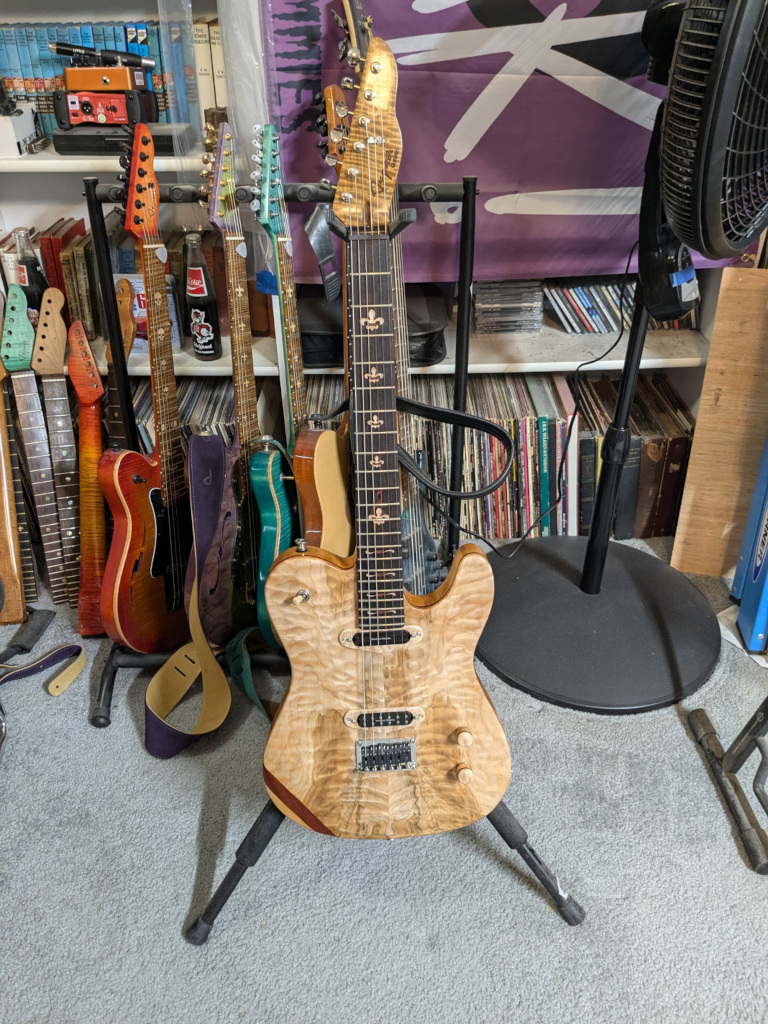
This one is spalted, quilted, colored big
leaf maple with a padauk layer and a basswood body. I
took it to a couple of gigs and realized that I had a
problem - I have very bad arthritis in my left hand.
Only my middle finger will bend or straighten at the
second knuckle. Because of this I have to play sort of
classical style with my hand completely under the
neck. When I went up above the 12th fret my hand
whacked into the horn. Since this guitar is mostly
hollow I couldn’t just shorten the horn so I decided
to make a short-horn Telecaster. I looked around the
interwebs and found a few but I didn’t like the
designs. The one I ran into most often just had a
lopped off horn. Ergonomically great, aesthetically
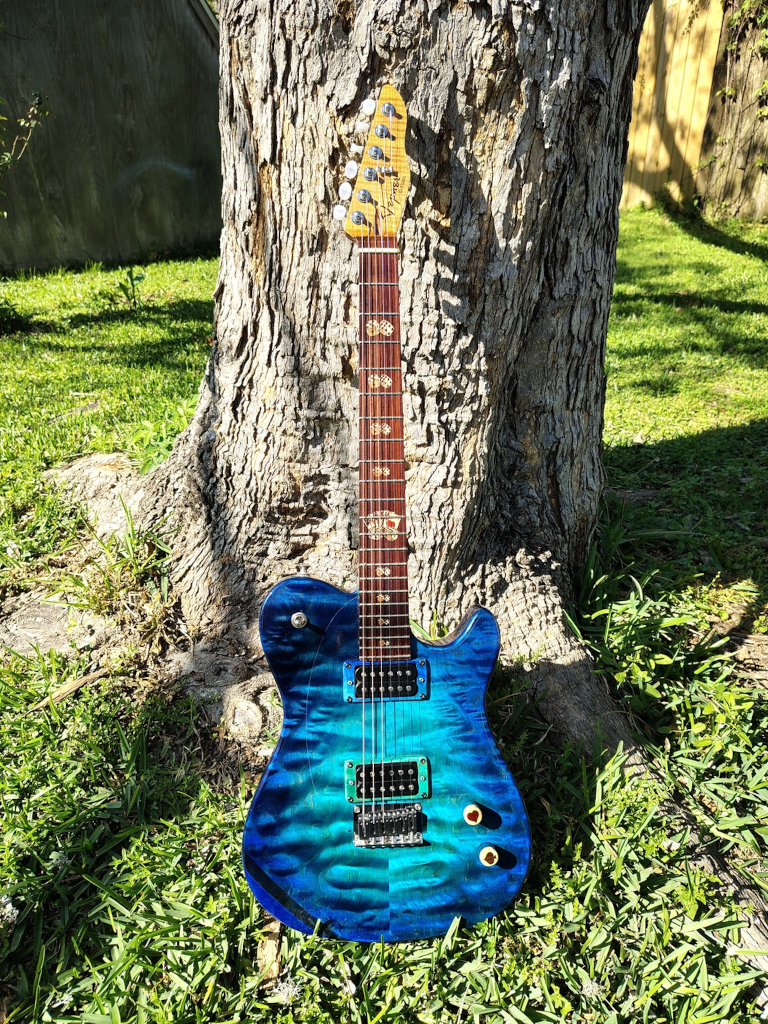
fugly. So, I decided to design my own short-horn. This
one is quilted big leaf maple over a walnut layer with
a basswood body. The fret markers aren’t stickers, the
marquetry inlay at the 12th fret has 24 separate
pieces of wood in it.
Within a few months of making this guitar my
band started having bass player problems (I think
we’re like Spinal Tap except that we go through bass
players instead of drummers) so I decided that we
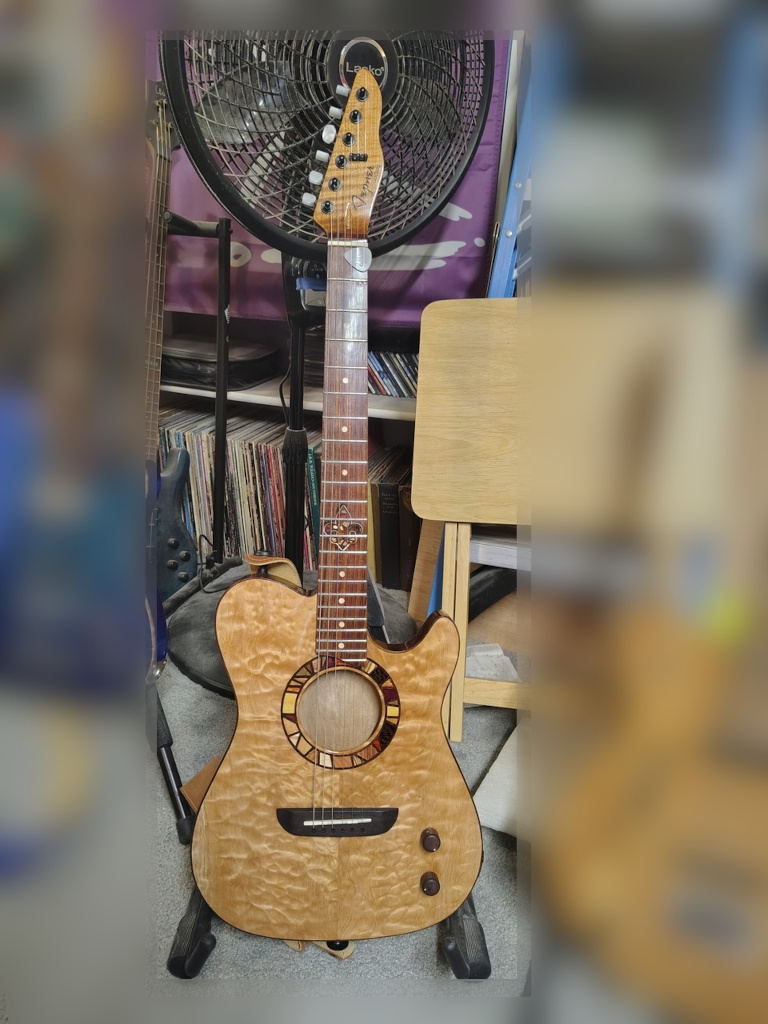
might need to go back to being an “acoustic” trio. For
that I needed an acoustic/electric guitar. I already
have a Carvin AC275 and it’s a great guitar but, due
to my arthritis, I need a 24.07 inch scale neck (which
all of these guitars have). Solution - make my own.
This entailed learning a bunch of new things like how
to cut a round sound hole, make a rosette, bend
rosewood binding, make a 3mm top, make an acoustic
bridge, and slot said bridge. I exchanged a bunch of
emails with Carvin and LR Baggs and ended up with an
LR Baggs Element VTC under saddle pickup. I scrapped
the included battery holder and volume/tone controls
and replaced them with A25K pots and a back mounted
battery box. This one is made of roasted basswood and
quilted big leaf maple. I used 18 or 19 different
types of wood in the rosette and fleur de lis (thanks
to Ocooch hardwoods for their veneer sampler).
Immediately after
I built this guitar we solved our bass player
problem but, being bored, I decided to try
something I’d always wanted to do - make a stealth
guitar. That is, one with the pickups completely
under the drop top. I had heard about people
considering doing this and there was a bunch of
noise about the Brad Paisley Secret Agent pickup
but I couldn’t find a guitar with no visible
pickups (other than ones with wood pickup covers
of course). I did a lot of thinking about how to
get the pickups as close to the strings as
possible. To this end I decided to recess the
bridge, lower the neck, and recess the underside
of the top where the pickups would reside. I used
Fishman Fluence Open Core active humbuckers (just
like in the blue guitar above) thinking that these
would be powerful enough to work at a distance of
between eight and nine millimeters from the
strings. The body is roasted basswood and spalted
hard maple. One of the reasons for trying this
little experiment is that it seems a shame to pay
a hundred bucks or more for a beautiful wood drop
top and then cover it up with a pickguard or
mounting rings. BTW, all of these guitars have
pickguards - 5mm laminating sheets from Amazon. If
you look real close you might be able to see them.
These let the beauty of the wood show but protect
it from pick damage. One other advantage of this
type of pickguard is that it is very inexpensive.
If you need to change pickup configuration you can
just peel it off. If you’d like to try it, search
on YouTube for a video of Frank Ford installing a
clear pickguard on an acoustic guitar.
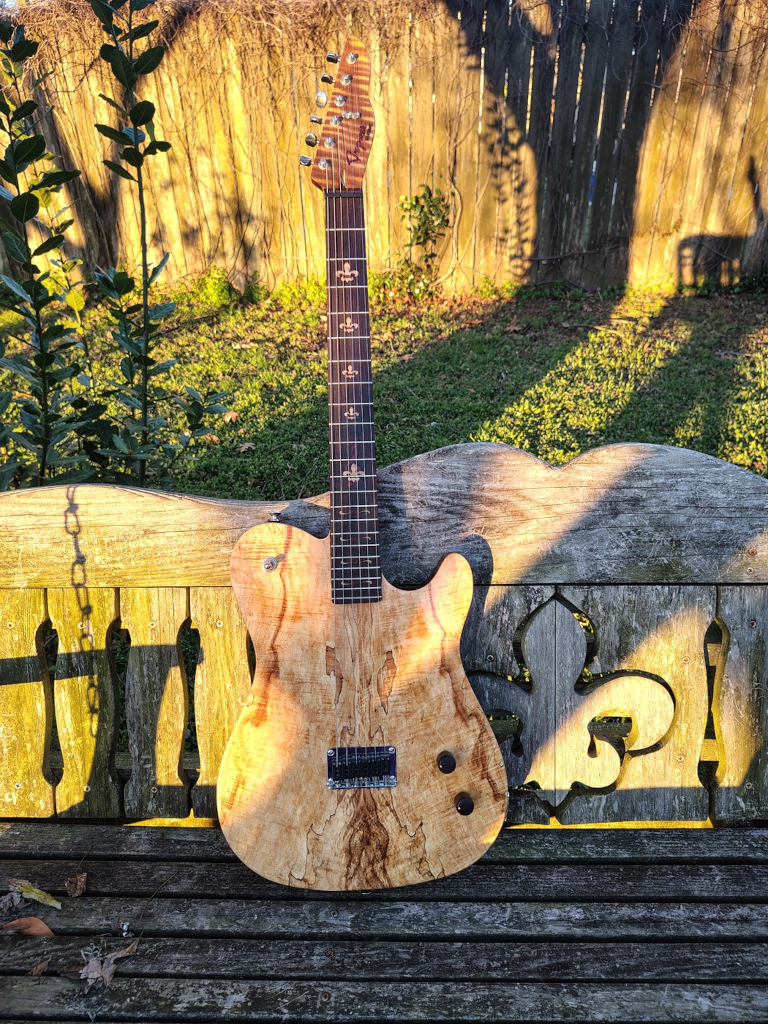
It
worked...sort of. If I were playing jazz this
would be pretty good. The sound was incredibly
clear but, if you wanted to give it some
power, it was a bit anemic. The other problem
is that if you have any kind of string
imbalance the only way to adjust the pickup is
to move it further away from the strings.
Luckily I had my contingency plan (Plan B From
Outer Space) - cut through the top and mount
the pickups with the mounting screws on the
top. Since the pickups are mounted through the
back this gives you a very clean top. Here’s
the back.
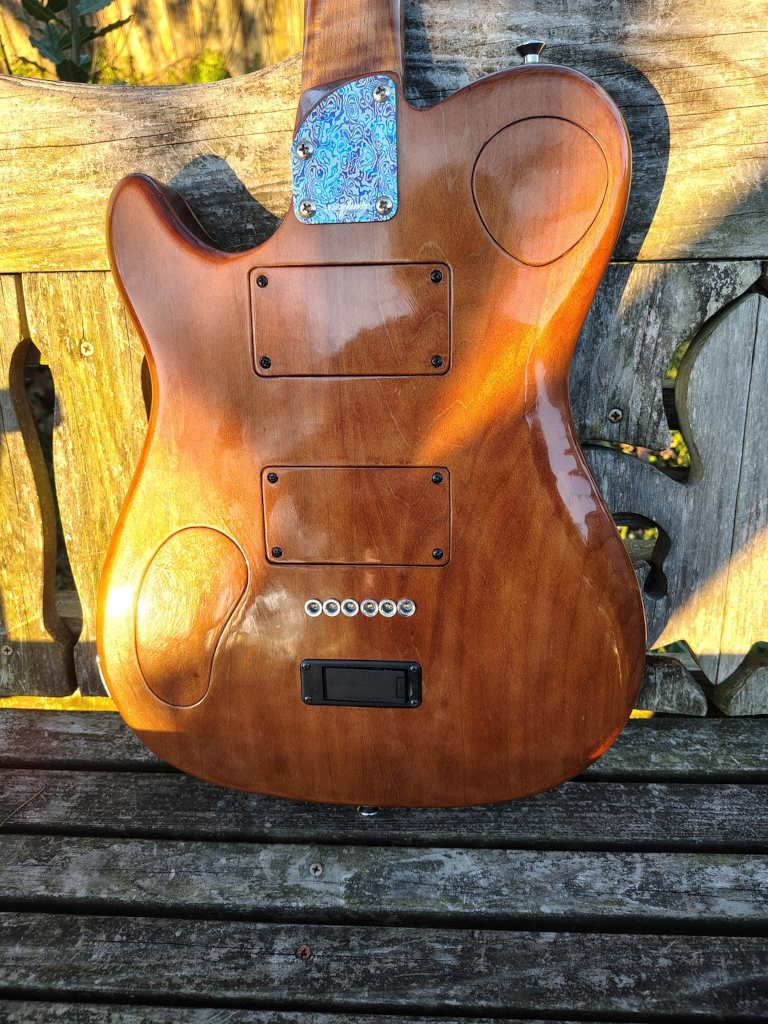
The
pickup covers are secured with screws but
the control cavity covers are held on with
5x2mm neodymium magnets. Here’s the top.
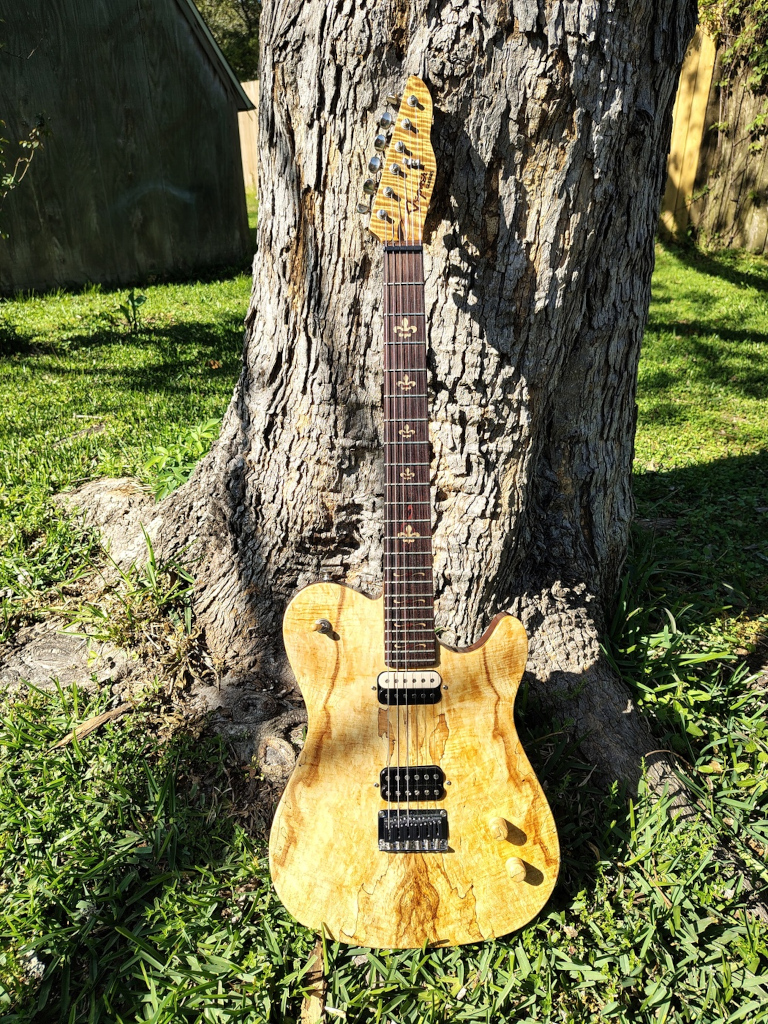
Note that
the fingerboard sits flat on the top like
an acoustic guitar. I started playing this
at gigs and something weird happened. I
really liked the lowered bridge and neck.
It’s incredibly comfortable to play and
palm muting is much easier. I actually
retrofitted the blue guitar in this
manner. The acoustic is already like that
because of the lower acoustic bridge. Oh,
BTW, if that neck looks familiar it's
because I stole it from the first
Telecaster style guitar. I gave the
Telecaster body to a friend.
All of these guitars were finished with GluBoost CA glue. You can finish a neck from sanded to buffed out in about three hours with this stuff. The body takes about a day. Wait time to completely cure is about ten minutes. If you’re really impatient you can get some GluDry. Funny thing about the CA finish for the neck - it isn’t sticky on very humid days even with the high gloss finish. I’m assuming that this is due to CA glue curing in the presence of water. I’ve never liked gloss lacquer necks because, here in the deep south, they get really sticky if it’s humid.
For the curious, here’s a picture of the inside of the guitar with the back of the drop top prior to gluing together. Note that I put the copper foil shielding on the drop top before gluing it to the body. I use copper foil tape for shielding because I have yet to find any of the “shielding paint” that passes the connectivity test with a DVOM. Another thing to note is that the sides and back are about 1/4” thick. That reduced the final weight (with pickups, bridge, strings and everything else) to 5 pounds and 2.3 ounces.
All of these guitars were finished with GluBoost CA glue. You can finish a neck from sanded to buffed out in about three hours with this stuff. The body takes about a day. Wait time to completely cure is about ten minutes. If you’re really impatient you can get some GluDry. Funny thing about the CA finish for the neck - it isn’t sticky on very humid days even with the high gloss finish. I’m assuming that this is due to CA glue curing in the presence of water. I’ve never liked gloss lacquer necks because, here in the deep south, they get really sticky if it’s humid.
For the curious, here’s a picture of the inside of the guitar with the back of the drop top prior to gluing together. Note that I put the copper foil shielding on the drop top before gluing it to the body. I use copper foil tape for shielding because I have yet to find any of the “shielding paint” that passes the connectivity test with a DVOM. Another thing to note is that the sides and back are about 1/4” thick. That reduced the final weight (with pickups, bridge, strings and everything else) to 5 pounds and 2.3 ounces.
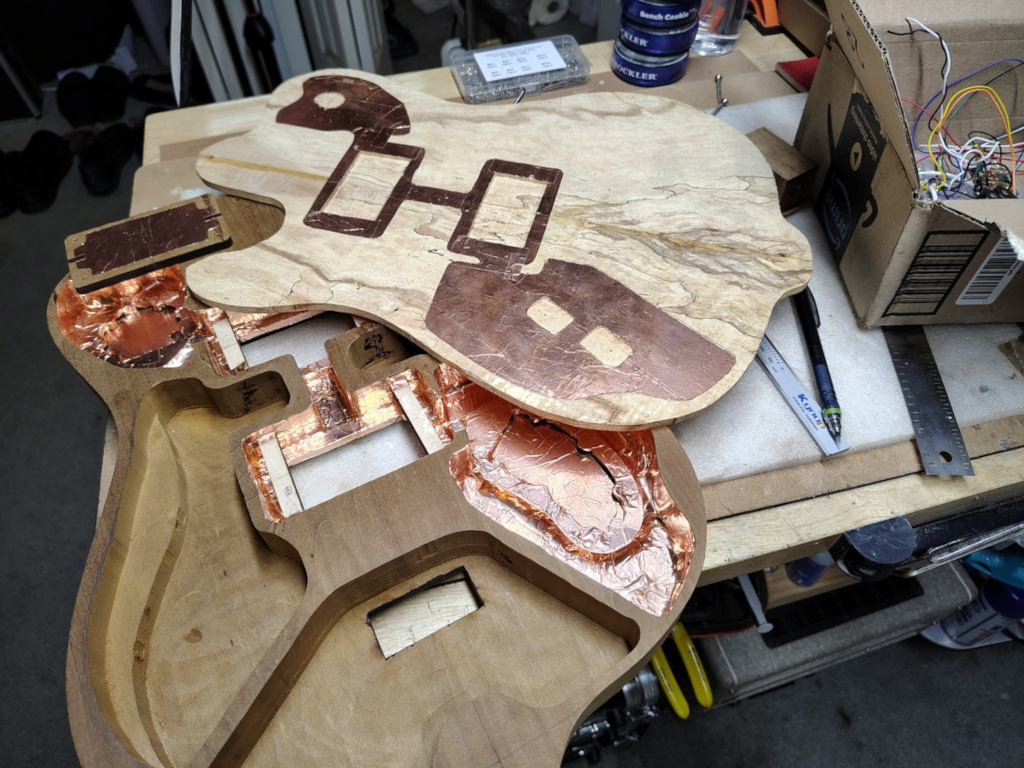
As for
the control and pickup cavity covers;
yes, I cheated. I used a Sculpfun S10,
10 watt diode laser (with blower - about
$700) to cut out the control cavity
covers from the body. That’s why the
grain matches on the back. You can do
almost the same thing by hand using a
template and whatever wood you want
although the grain won't match.